Sherpa connects businesses and drivers to deliver products locally within hours — powering last-mile logistics for some of Australia's leading retailers and eCommerce brands.
From manual process to smart prompts
Before this feature existed, Sherpa's tracking agents relied on SMS and phone calls to follow up with drivers who appeared delayed. It was repetitive, time-consuming work — drivers were often in transit or mid-delivery and unable to respond, while agents had no reliable way to update customers waiting on their deliveries.
The opportunity was clear: automate the communication without adding complexity. Rather than building new behaviours from scratch, I wanted to design around the ones already working — turning an operational bottleneck into something that felt effortless for both sides.
Two connected features emerged:
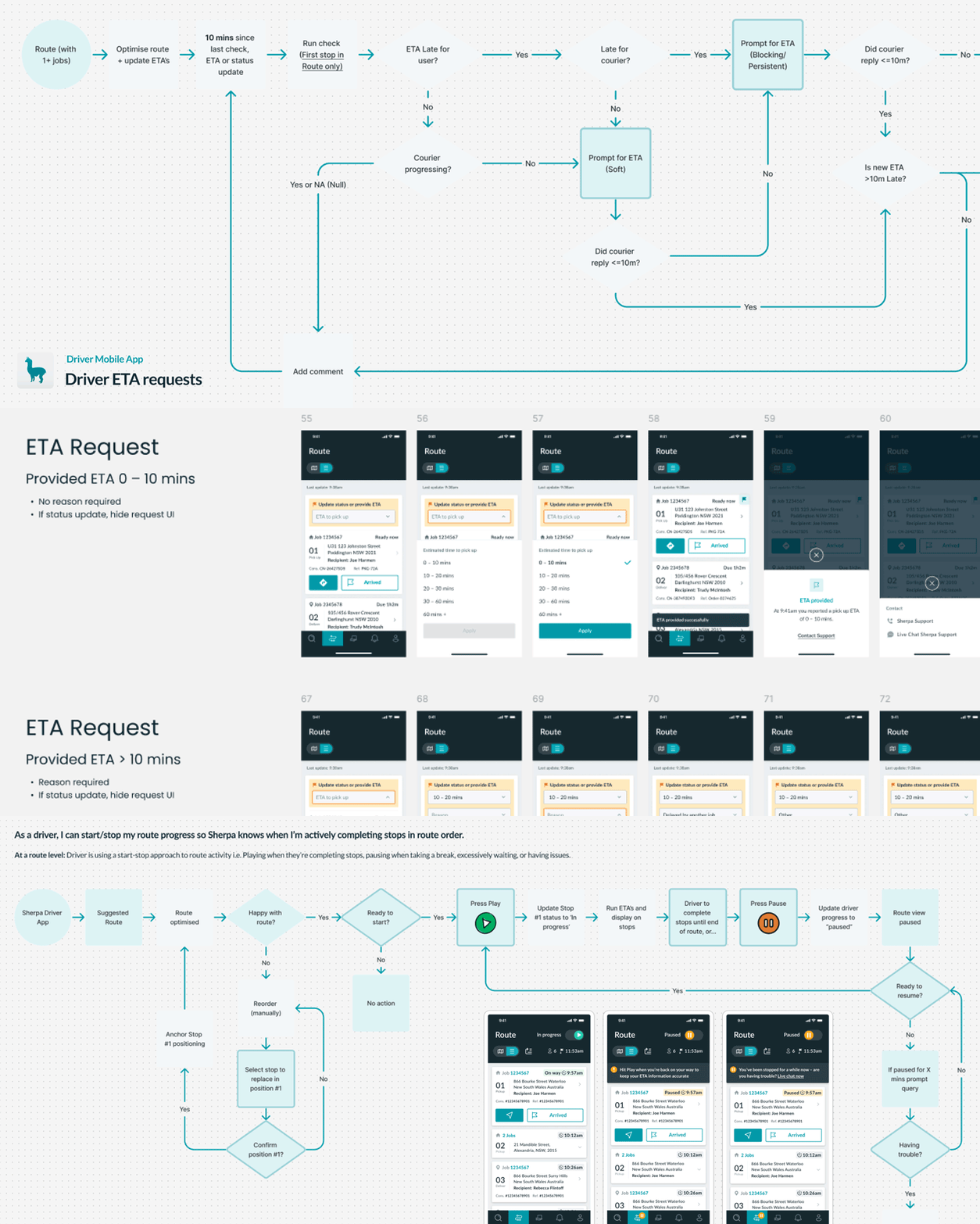
ETA Requests – an agent-triggered prompt sent when a delivery appeared delayed, allowing the driver to respond directly in-app and update the job in real time.
On My Way – a proactive driver action letting them indicate when they were en route and to which job or stop, giving agents visibility before they even needed to ask.
Together, they turned ETA management from a manual chase into a simple, context-aware interaction.
Designing for real-world constraints
Working with limited budget and engineering capacity meant being ruthless about scope. Integration of in-app maps would have addressed several operational challenges at once, but it required an investment the business was not ready to make. So we focused on what could deliver the most impact immediately: human-centred automation built on existing data and behaviour.
A few principles shaped every decision in the design process.
Timing-conscious by default.
Drivers could reply when it was safe and convenient — no switching apps, no breaking their flow. The feature had to work around their day, not interrupt it.
Smart triggers, not blanket prompts.
Existing location data and job status information determined when ETA requests were surfaced, avoiding unnecessary interruptions and keeping the signal meaningful.
Automatic visibility for agents.
Responses updated delivery logs and reprioritised jobs in the watch list without any manual input — reducing oversight burden and giving agents confidence in what they were seeing.
Design process
I began by mapping where this feature would intersect with the existing delivery flow — looking at how to reconfigure current driver actions rather than layer new ones on top, and how existing data could inform when and whether to prompt for an ETA at all.
We explored several directions. Job-level actions kept drivers focused on their next stop, providing clarity and context within the immediate task. Route-level controls offered more flexibility — the ability to reorder stops, pause progress, or proactively flag a delay. Through prototyping and feedback sessions with drivers and agents, we converged on an interface that met drivers where they were, making ETA responses feel like a natural part of their workflow rather than an additional obligation.
The backend logic was deliberately built for flexibility — a foundation that could evolve alongside more sophisticated automation in future releases. The rollout followed an iterative approach: launch an MVP, gather data, refine. Before launch, the data team built a Looker dashboard to track driver response rates, ETA accuracy, message volumes, and on-time delivery metrics. Follow-up interviews with drivers and agents after launch confirmed what the data was showing — smoother workflows, significantly less manual contact, and greater confidence in the system on both sides.
Impact
Six weeks post-launch, the results validated the approach.
Manual ETA-related SMS volume dropped by approximately 70% — meaningfully reducing operational costs and agent workload almost immediately.
Of all ETA requests sent, 78% resulted in either a specific ETA response or a delivery status update within ten minutes. Only 22% were left without any response or delivery progress in that window.
The improvement was not just operational. Drivers reported feeling less interrupted. Agents reported greater confidence in the information they had. And the feature created a data foundation that opened the door to future automation — including location-based reminders and fully automated ETA prompts triggered by driver position and job status, requiring no agent involvement at all.
A key takeaway
This project reinforced something I come back to often: incremental, well-considered design can create significant operational clarity, even within tight constraints.
By focusing on what mattered most — making communication simpler, faster, and safer for the people actually doing the work — we built something that reduced the repetitive without removing the human. Sherpa's team became more efficient without losing the personal touch that defines their service where it matters most.
It is a principle that applies well beyond logistics. The best product decisions are rarely the most ambitious ones. They are the ones that understand the existing system well enough to improve it with the least possible disruption.